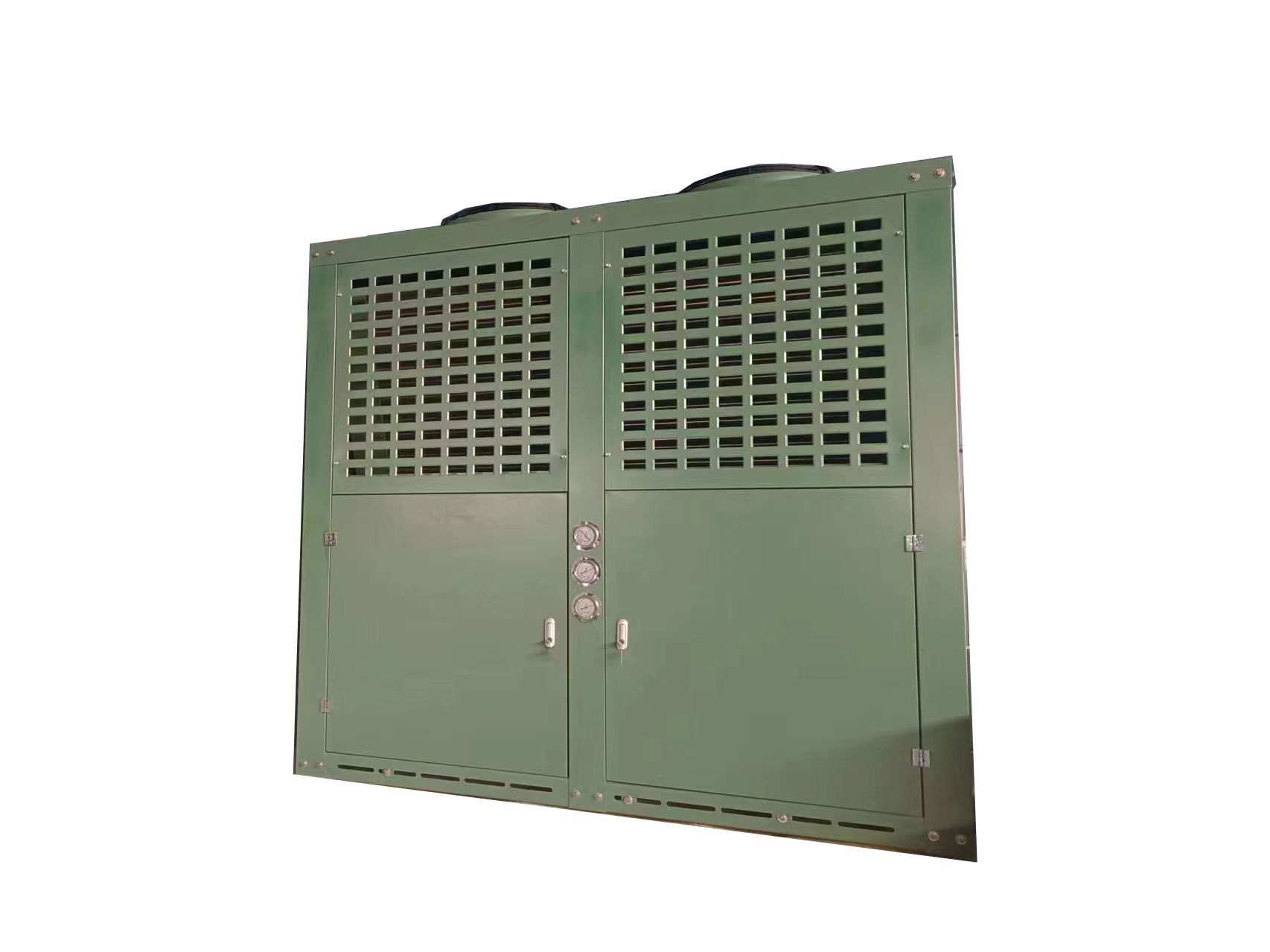
condenser
- product brand:Huaxia Kaidi
- رقم الكشك:A1J31
- product specification:
- product category:Refrigeration Equipment-Refrigeration systems and plants-Chillers, liquid
- product introduction:A condenser is a key component in a refrigeration system that is mainly used to cool high temperature and high pressure refrigerant steam to condense into a liquid while transferring heat to a cooling medium such as water or air. Here is a detailed description of the condenser: 1. How it works The condenser is a heat exchange process that causes the refrigerant vapor to gradually cool down under the action of the cooling medium and change froma gas to a liquid state. The specific process is as follows: After the refrigerant vapor entersthe condenser, it is first cooled to saturated steam; Continue cooling to make it condense into a saturated liquid; If the cooling medium has a large flow and a low temperature, the saturated liquid can be further cooled into an overcooled liquid. 2. Major Types Based on thecooling medium and structural form, condensers can be divided into the following categories: Water-cooled condensers: Shell-tube condensers: divided into standing and standing types. The horizontal shell condenser cooling water flows under pressure through the horizontal tube, has a high heat transfer coefficient, and is suitable for large and medium ammonia or fluorine refrigeration units; The horizontal shell condenser cools water by gravity down the pipe and is suitable for large ammonia refrigeration installations. Conduit-type condenser consists of internal and external tubes. The refrigerant condenses in a cavity between the internal and external pipes. The cooling water flows in the internal pipes. It has good heat transfer effect and is often used in small fluorine air conditioning units. Air-cooled codensers: Natural convection: Relying on natural convection of air to dissipate heat, they ae suitable for devices with small refrigeration capacity, such as home refrigerators, with little noise but low heat transfer coefficient. Forced convection mode: Forced air flow througha fan, with high heat transfer efficiency, is often used in domestic air conditioners, automobile air conditioner, etc. The structure is compact but noisey. Evaporative condenser: Usinga sprinkler water to evaporate in the air to absorb heat, refrigerant vapor condenses. It circulates less water and is suitable for water-scarce areas, but the water quality requirementsare high, and it needs to be cleaned regularly to prevent blockage of the head and foulingof the pipe group. The drainage condenser: It consists of a drainage tank, a condensationdisc and a catchment. The cooling water flows in a membrane along the surface of the disc, relying on the temperature of the water and evaporation to take away the heat. It is suitable for large and medium-sized ammonia refrigeration systems. The structure is simple butthe heat transfer coefficient is low. 3. Selection and application The selection of the condenser needs to be considered according to the requirements of the refrigeration system, the conditions of the cooling medium, and space constraints. For example, in areas with abundant water resources, water-cooled condensers are highly efficient and have low operatingcosts. Air-cooled or evaporated condensers are more suitable in situations where water isscarce or unavailable; Automotive air conditioners often use forced convection air cooling condensers to adapt to vehicle space and environmental conditions. 4. Maintenance and maintenance To ensure the efficient operation of the condenser, it is necessary to perform regular maintenance: cleaning the heat transter surtace to prevent the accumulation of dirt and oil to affect the heat transfer efficiency; Check the flow and temperature of the coolingmedium to ensure the cooling effect, Eliminate condensate gases from the system to avoideducing heat transfer. As the core component of the refrigeration system, the performanceof the condenser directly affects the refrigeration effect and energy efficiency ratio of the system. Rational selection, correct installation and regular maintenance are the key to ensuring the long-term stable operation of the condenser.